
Underwater Photography
for Beginners
It is 1993. I am on my honeymoon at Baros in the Malé Atoll — my first visit to the Maldives. I have borrowed my brother-in-law’s video camera. It cannot go underwater. But the black tip reef sharks are hunting baitfish in the shallows, driving them into panicked silver balls right at the shoreline, and I am not prepared to miss it.
So I find a clear plastic food container, press it lens-first against the surface of the water, and film through it. The footage is terrible. It is also completely magical. Those sharks, those baitfish, that moment — captured on a borrowed camera pressed inside a tupperware box by a man in board shorts standing in six inches of water. I have never forgotten it.
Thirty-three years and nearly forty Maldives visits later, the desire to capture what lies beneath the surface has not changed at all. The technology available to do it, however, is unrecognisable.
This guide is not for professional underwater photographers. It is for everyone else — the Maldives visitor who wants to bring home something that actually captures what they saw, without spending a fortune, without specialist training, and without missing the experience itself while fiddling with equipment. Everything here is drawn from personal experience, across multiple cameras, across three decades of Maldives visits.
Why Bother at All?
The Maldives is one of the most visually extraordinary places on earth — above and below the water. The coral gardens, the reef fish, the turtles, the sharks, the rays — these are not things that translate well into words or into memory alone. You will want to show people. You will want to remind yourself, twenty years from now, exactly what it felt like to be in that water on that day.
Photography above the water is easy. Everyone manages it. Underwater photography feels intimidating — technical, expensive, specialist. In reality, the gap between what a modern consumer action camera can capture and what a professional rig produces has narrowed to a point where, for social media, YouTube, and personal memories, a £300 camera in the hands of an enthusiastic amateur produces results that are genuinely stunning.
I know this because I have the footage. And I am, by any objective measure, an enthusiastic amateur who does not really know what he is doing.
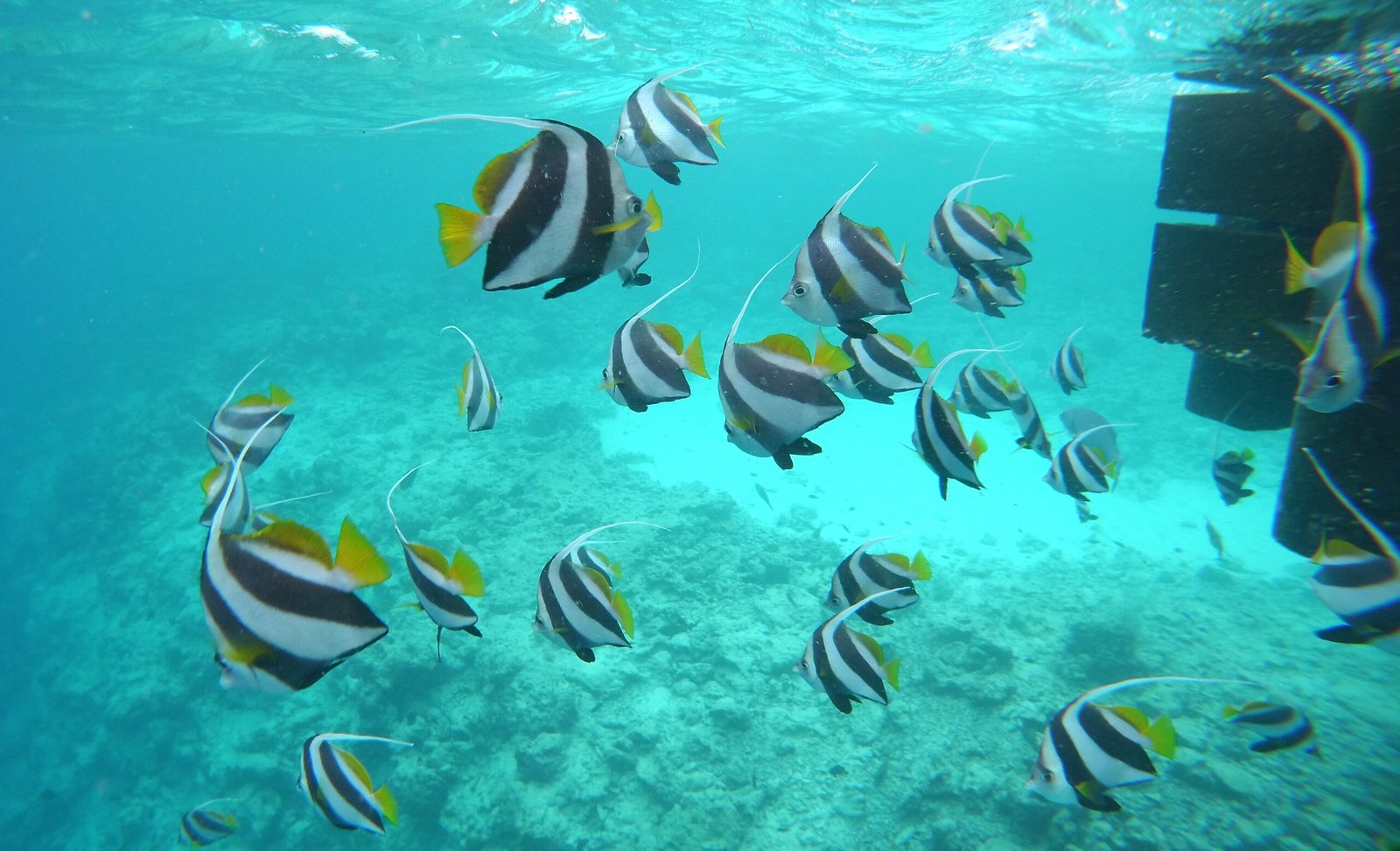
My Camera Journey — From Tupperware to 4K
After the borrowed video camera and the plastic container, I spent many years taking nothing underwater at all. Dedicated underwater cameras existed but were expensive, bulky, and produced results that rarely justified the effort. Disposable underwater film cameras were fun but the results were usually disappointing — grainy, dark, and difficult to share before the digital era.
When action cameras arrived and the underwater housing technology matured, everything changed. My first serious underwater camera was the Nikon KeyMission 170 — a dedicated action camera that Nikon produced for a few years before discontinuing it. It was genuinely excellent for its time. Compact, capable of 4K video, with good underwater performance and a wide-angle lens that captured the spatial feeling of being in open water rather than the compressed tunnel view of earlier cameras. I used it across multiple Maldives trips and loved it. When it eventually died, I was genuinely sad to see it go.
Finding a direct replacement for the KeyMission proved impossible — Nikon had exited the action camera market entirely. After considerable research I moved to the DJI Osmo Action 1, which I have now used for several Maldives trips and which produces results that genuinely exceed what the KeyMission achieved. The footage is sharper, the colour is more accurate underwater, and the stabilisation is remarkable for handheld shooting in moving water.
The turtle footage I am most proud of — twenty minutes of a green turtle swimming alongside me at close range, captured entirely on the Osmo Action 1 — is the best underwater footage I have ever taken. It is also, technically, some of the most amateur footage I have ever taken. Handheld, single operator, no lighting, no dive buddy holding a secondary camera. Just a man, a turtle, and a £300 action camera.
That is the point of this guide. You do not need to be a professional. You need the right camera, held correctly, in the right place at the right time.
How I Hold the Camera — The Hand Strap Method
Equipment choice matters. How you hold it matters just as much — and almost nobody talks about this.
I use a GoPro hand and wrist strap with my DJI Osmo Action — the camera sits on the back of my hand, secured to my wrist. My arms move freely in a normal swimming stroke. When something worth filming presents itself — a turtle, a ray, a shark working the reef — I simply raise my hand toward the subject and the camera is already pointing in the right direction.
I have tried pole mounts, selfie sticks, and wrist mounts. None of them work as naturally in open water. A pole restricts your stroke and makes you work harder to swim. A wrist mount angles the camera sideways and requires awkward arm positioning to get the shot. The hand strap keeps the camera ready without affecting how you move through the water at all.
The other technique worth knowing — switch between photo and video mode frequently rather than committing to one. My instinct when something extraordinary appears is to panic about whether I am in the right mode and miss the moment entirely. Switching continuously throughout a snorkel session means that whenever something remarkable happens, you have a reasonable chance of being in whichever mode would have captured it best. You will end up with more footage than you need and will sort it out later. That is a much better problem than missing the shot.
Which Camera Should You Buy?
The honest answer depends on your budget and how seriously you want to take it. Here is my genuine recommendation across three tiers.
DJI Osmo Action 6
The camera I would buy todayThe latest generation DJI Osmo Action 6 represents the best consumer underwater camera available right now at a sensible price point. Variable aperture — a feature previously found only on professional equipment — gives you meaningful control over exposure in the transition between bright surface light and darker reef conditions. The stabilisation is exceptional for handheld shooting, colour science underwater is genuinely good without post-processing, and the build quality is everything you would expect from DJI. If you are buying one camera for the Maldives and want the best available at this price point, this is it.
DJI Osmo Action 5
Outstanding results at a lower priceThe DJI Osmo Action 5 remains an outstanding camera and will produce results that are difficult to distinguish from the Action 6 in most real-world snorkelling conditions. If the Action 6 price gives you pause, the Action 5 is not a compromise — it is a genuinely excellent camera that I used personally across multiple Maldives trips in its predecessor form. The stabilisation, colour performance, and build quality are all excellent. For most Maldives visitors, the Action 5 is all the camera they will ever need.
GoPro Hero 13 Black
The most recognised name in action camerasGoPro invented the action camera category and the GoPro Hero 13 is their finest camera to date. The brand recognition means a wider ecosystem of accessories, more community support and tutorials, and the confidence of buying from the company that has been doing this longest. Underwater performance is excellent and the image quality is superb. My personal preference is DJI for colour science and stabilisation, but the GoPro Hero 13 is a genuinely outstanding camera that many serious underwater photographers prefer. Either choice will produce results that will astonish you.
The Essential Accessory
Whichever camera you choose, buy the GoPro hand and wrist strap alongside it. It is compatible with both GoPro and DJI cameras via the standard mount. At around £20 it is the single best accessory purchase you will make — more impactful on your actual footage than any camera upgrade. The hand strap method, described above, is the technique that transformed my underwater photography from awkward and exhausting to natural and instinctive.
What to Realistically Expect
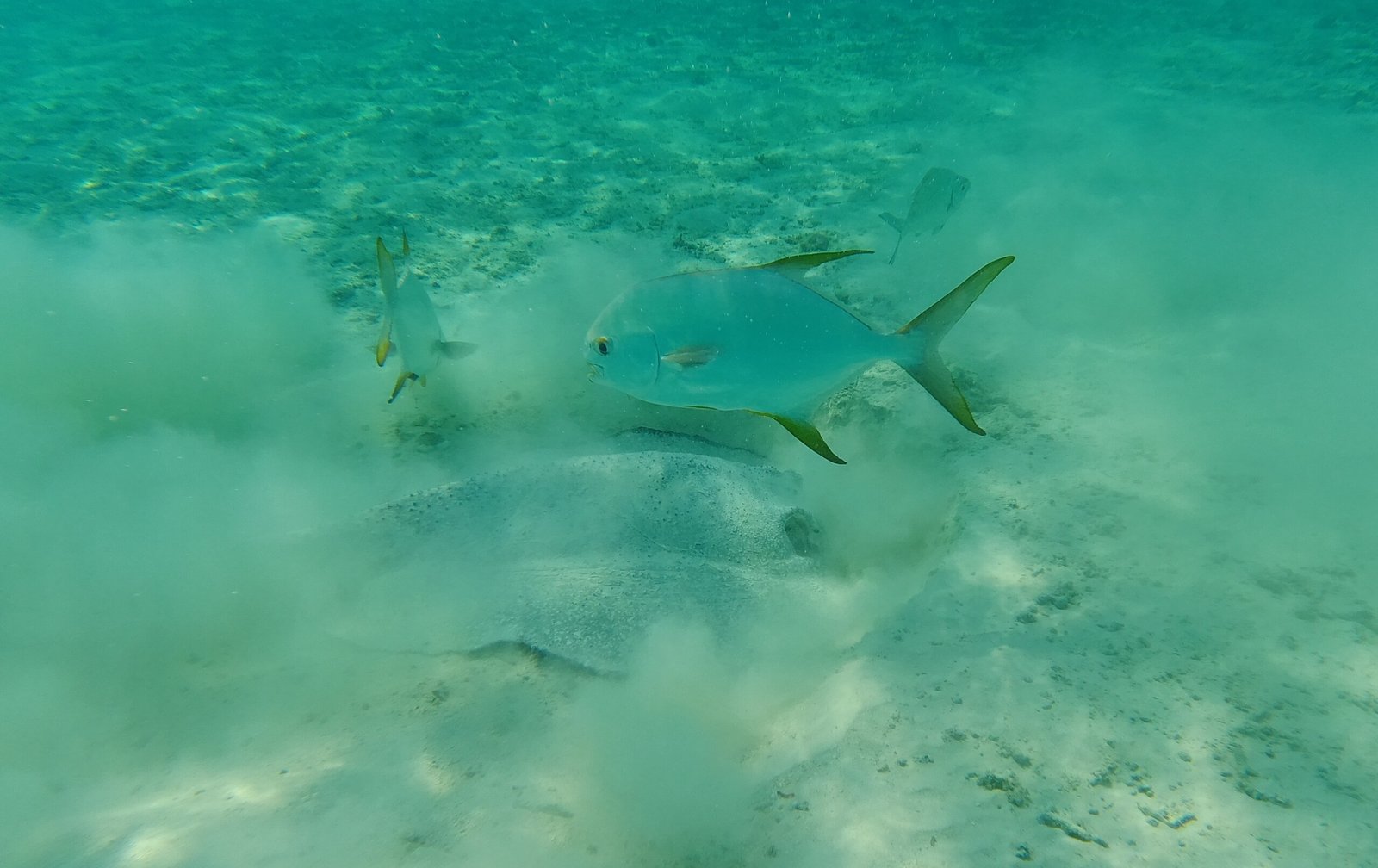
Be honest with yourself about the gap between professional underwater photography and what a consumer action camera produces in amateur hands. The gap is real — and it matters less than you think.
Professional underwater photographers use dedicated housing rigs, external strobes to restore colour at depth, wide-angle wet lenses, and years of practice composing shots in three-dimensional moving water. Their images are technically perfect. They are also taken by people whose job it is to be in that water with that equipment for hours at a time.
Your footage will be shakier. The colour will be more blue-green than a professionally corrected image. Some shots will be blurry. The framing will occasionally be wrong. And when you watch it back — when you see a green turtle filling the frame, close enough to touch, swimming alongside you in open ocean — none of that will matter in the slightest.
The turtle footage I treasure most was shot handheld, without a dive buddy, in natural light, by someone swimming as fast as he could to keep up with a turtle that had decided, for reasons known only to itself, to spend twenty minutes with a middle-aged Englishman in the Indian Ocean. It is imperfect in almost every technical sense. It is the most extraordinary footage I have ever taken.
“You do not need perfect footage. You need something that takes you back there — to that water, that light, that turtle — twenty years from now. A £300 action camera is more than capable of doing exactly that.”
Safety — The Most Important Section
Underwater photography introduces a specific and serious safety risk that every snorkeller with a camera needs to understand before getting in the water.
When you are filming, your attention is on the screen or viewfinder. You are thinking about framing, about following the subject, about whether you are in photo or video mode. You are not thinking about where you are, what the current is doing, or what is happening around you. This narrowing of awareness is the single greatest risk that cameras introduce to snorkelling.
Maldives currents can be powerful and change quickly, particularly on the ocean-facing sides of atolls and around reef passages. A snorkeller who is filming a turtle and not monitoring their position can drift a significant distance from the beach or the boat without realising it. By the time they look up, the distance back may be beyond their comfortable swimming ability.
Before you enter the water with a camera, establish the following habits without exception:
Check your position every sixty seconds. Look up from the camera, identify where the beach or the boat is, and assess whether the current has moved you. This takes five seconds and should become completely automatic.
Never snorkel alone with a camera. Bad practice in any snorkelling context — worse when your attention is divided between the viewfinder and the world around you. Always snorkel with at least one other person who is not filming and can monitor your collective position and safety.
Know the current before you enter. Ask the resort dive centre about current conditions before each session. Maldives resorts have this information and will share it honestly. A current that is safe for an experienced swimmer may be dangerous for someone who is simultaneously trying to film.
Set a distance limit from shore. Agree before you enter the water how far from the beach or boat you will go, and turn back before you reach it. The camera makes it very easy to follow a subject further than is comfortable or safe.
I mention this not to discourage underwater photography — it is one of the great joys of a Maldives holiday — but because I have seen guests drift into uncomfortable positions while filming, and the awareness of the risk is the entire protection against it. Camera in the water, eyes on the world around you. Both, always.
What the Maldives Resorts Provide
Most luxury and higher-end Maldives resorts have dive centres that offer underwater camera rental — typically GoPro units available by the day or half-day. The quality of rental equipment is generally good at this level, and if you are uncertain whether underwater photography is for you before investing in your own equipment, a resort rental session is an excellent way to find out.
Some ultra-luxury resorts — Kudadoo Private Island and Soneva Jani among them — provide snorkelling and photography equipment as part of the all-inclusive experience, with staff from the dive centre available to guide you to the best reef locations and marine life encounters. This is the optimal introduction to underwater photography for a first-timer — experienced guidance, good equipment, and the best possible locations combined.
At mid-range and budget resorts, camera rental is less consistent. If underwater photography matters to you, bringing your own equipment is always the right choice at any resort tier.
Final Advice
Start simply. Choose a camera — the DJI Osmo Action 6 is where I would start today, the Osmo Action 5 if budget matters, the GoPro Hero 13 if you prefer that ecosystem. Add the hand strap. Get in the water. Point it at things. Look up every sixty seconds. Swim back before you are tired.
The rest takes care of itself. The Maldives provides the subjects. The ocean provides the light. Your camera provides the memory.
A borrowed video camera pressed inside a plastic container against the surface of the water in 1993 started me on this journey. Thirty-three years later I am still in that water, still pointing cameras at things, still occasionally getting footage that stops me in my tracks when I watch it back.
That is all this is. Get in the water. Point the camera. Everything else is detail.
As an Amazon Associate I earn from qualifying purchases. This does not affect the price you pay or my editorial independence — I only recommend products I personally use and trust.
Find a Resort With an Exceptional House Reef
Tell our AI concierge your priorities and get matched to your ideal Maldives island — including the best snorkelling and marine life — from 200+ resorts
✦ Find My Perfect Resort →